Have you been wondering what your “five-year plan” is or trying to find your main passion or life goal?
How many times have you scrolled past someone on social media announcing their “dream job” or ‘life’s calling” and felt that familiar, sinking feeling of… “Wait, what am I even doing?”
For students and young professionals, the pressure to find your “passion” can be completely paralyzing. It feels like everyone else got handed their “Main Quest” in the tutorial, while you’re still wandering around the starting village, stuck, and totally lost.
This pressure turns a journey of discovery into a high-stress, high-stakes test that you feel you’re already failing.
But what if we changed the rules of the game?
What if finding your passion wasn’t a single, terrifying, all-or-nothing decision? What if it were a game? A playful, exploratory, and fun RPG (Role-Playing Game) where you are the main character.
At Gameful Bits, we believe this is a much better way to play. So, grab a fresh sheet of paper. It’s time to stop panicking and start playing. Welcome to the gameful guide to finding your Main Quest.
Part 1: Character Creation (Before You Quest, Know Your Character)
In any good RPG, you don’t just jump into the game. You spend time in the “Character Creation” screen, carefully designing your hero. You can’t just accept a quest to become a ‘Level 90 Warrior’ if your Core Strength Stat is very low.
The same goes for life. We sometimes get so stressed trying to choose a career (a Main Quest) that we forget to figure out who our character is first.
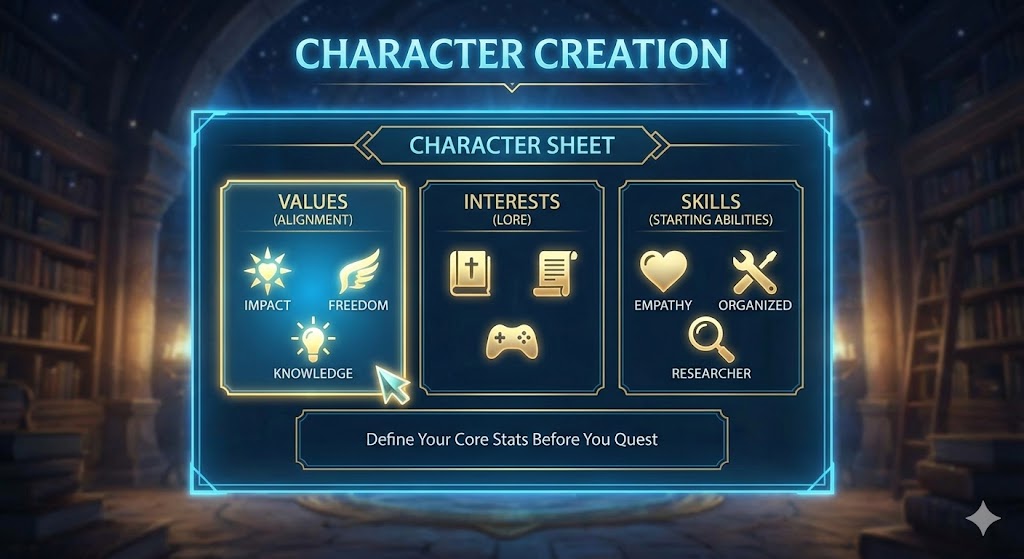
Let’s build your Character Sheet!
1. Define Your “Core Stats” (The Big 3)
These are the non-negotiable stats that make you you.
- Your Values (Your “Alignment”): This is your “why.” It’s your character’s moral compass. Are you driven by structure, impact, and helping society? Or by freedom, creativity, and challenging the status quo? Or by knowledge, balance, and logic?
- Mini-Quest: Grab a pen. Write down your top 3 “must-haves” from this list: Security, Creativity, Impact, Freedom, Knowledge, Connection, Justice, Growth, Fun. Any “Main Quest” you take must align with these values, or it will always feel like a grind.
- Your Interests (Your “Lore”): This is your unique backstory. What topics do you fall into a research rabbit hole for at 2 AM? What do you do when you’re procrastinating? What did you love as a kid before you worried about a paycheque?
- Mini-Quest: Think of this as “loading an old save file.” Write down 3 things you’ve always loved, no matter how silly or unproductive they seem. (e.g., organizing junk drawers, explaining complicated movie plots to friends, building wild creations in video games). This is your character’s “lore,” and it’s full of clues.
- Your Skills (Your “Starting Abilities”): This is what you’re already good at. We’re often blind to our own best skills! “This isn’t just hard skills like Python or Organic Chemistry. It’s your soft skills, too.
- Mini-Quest: List one skill for each of these categories:
- A “Support” Skill: (e.g., Empathy, great listener, patient teacher)
- A “Tank” Skill: (e.g., Super organized, calm in a crisis, reliable)
- A “Rogue” Skill: (e.g., Witty, great at finding shortcuts, persuasive)
- A “Mage” Skill: (e.g., Deep researcher, loves data, good at strategy)
- This isn’t just a list; it’s an inventory of the tools you already have, a direct counter to that “skills gap” anxiety.
- Mini-Quest: List one skill for each of these categories:
2. Choose Your “Class” (How You Play)
Notice we haven’t mentioned a single job title. That’s because a “job” is just one way to express your “Class.” Your Class is how you naturally like to play the game of life.
- The Builder (or ‘Warrior’): You love to make things. You get a rush from seeing a tangible result. (e.g., coders, artists, engineers, project managers who build a plan from scratch).
- The Support (or ‘Healer’): You love to empower people. You get energy from helping, teaching, and connecting. (e.g., teachers, nurses, community managers, great leaders).
- The Scholar (or ‘Mage’): You love to understand things. You get a thrill from deep research, complex data, and finding the “why.” (e.g., scientists, data analysts, researchers, journalists).
- The Explorer (or ‘Rogue’): You love to find new ways. You’re driven by curiosity, freedom, and challenging the status quo. (e.g., entrepreneurs, designers, travel writers, innovators).
Pause. Look at your Character Sheet.
You’re not a “Confused 23-Year-Old”. You’re a “Builder with high empathy, calm in a crisis, persuasive, and good a strategy, who seeks impact, freedom, and knowledge.”
See? That’s a character with direction! Now, it’s time to explore the map!
Part 2: World Map Exploration (The How-To Guide to Finding Your Quest)
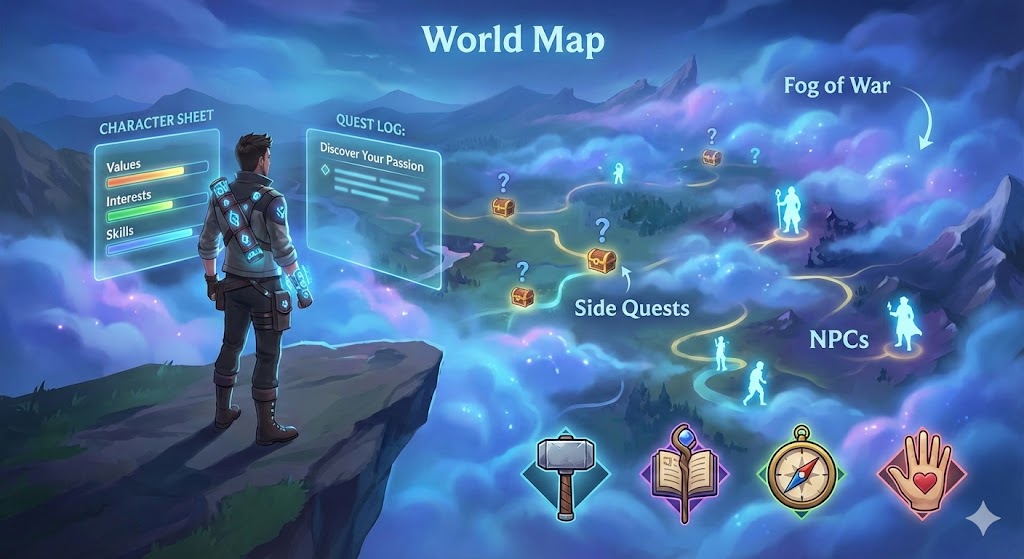
Okay, new character. You’re standing in the starting zone. The entire “World Map” is covered in a “Fog of War.” This is the part where most people panic. They want the entire path to the “Final Boss” (also known as “Career Success”) revealed right now.
That’s not a game. That’s a movie.
The fun of an RPG is in the exploration. The “Fog of War” isn’t your enemy; it’s the adventure. Your job isn’t to guess the right path; it’s to start walking and reveal the map, one step at a time.
Here’s how!
1. Accept all the “Side Quests”
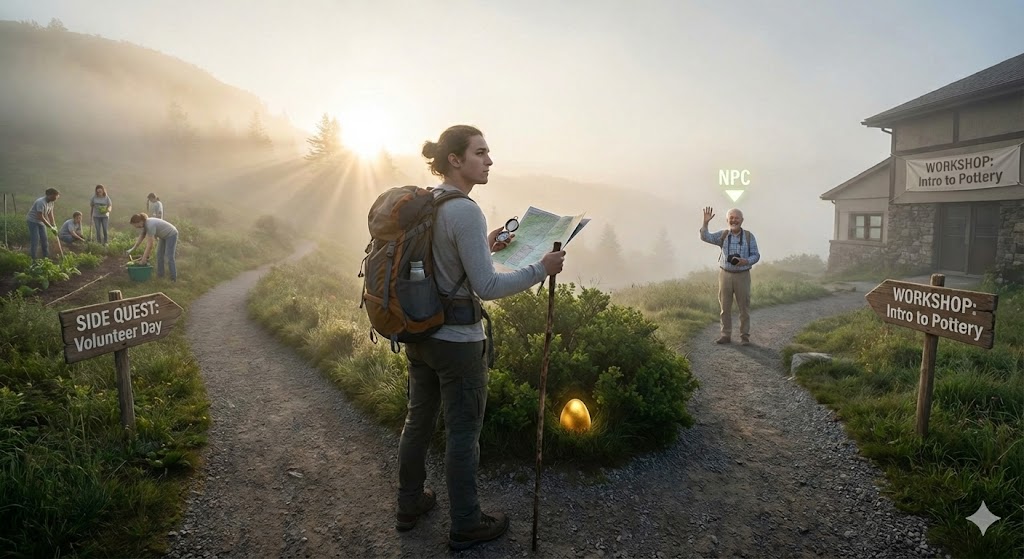
This is a very important rule. A “side quest” is any low-risk, short-term experiment.
- Volunteer for one day at a non-profit.
- Take a $20 online workshop in a random skill.
- Join a university club that has nothing to do with your major.
- Offer to help a friend with their passion project for a few hours.
High achievers often see these as distractions from their Main Quest. However, if you don’t have your main quest well defined yet, this may be a critical error.
Side Quests are how you “grind XP” and “test your build” without any pressure. Did that coding side quest feel like a total slog? Cool! Data collected. You’re probably not a “Builder-Mage.” Did that organizing side quest for your friend’s event make you feel alive? Clue! You might be a “Support-Tank.”
The goal of a side quest isn’t to find your “forever.” It’s to collect data. Did this quest replenish your “Stamina Bar” or did it drain it?
2. “Chat with NPCs” (aka The Fun Way to Network)
In a game, you talk to “Non-Player Characters” (NPCs) to unlock new quests and get clues. In life, you do the same.
We call this “networking,” and it feels awful. So don’t “network.” Just “Chat with NPCs.”
An NPC, in our game, is any “Non-judgmental, Potentially-helpful Contact.” It’s your cousin’s friend, a professor, an alum on LinkedIn, or that person you follow who has a cool job.
You’re not asking them for a job (a high-pressure quest). You’re just asking about their game.
- The Quest-Giver Script: “Hi [Name], this might be random, but I’m in ‘Character Creation’ mode, trying to explore my career options. Your career path seems like such a high-level questline, and I’d be fascinated to hear about your daily tasks and big goals. Would you be open to a 15-minute chat?”
This disarms them, makes it fun, and turns a transaction into a conversation. You’ll get more honest answers and way more help.
3. Look for “Easter Eggs” in Your Current Level
Even if you’re on a grindy level you hate, such as a boring class or an entry-level job that’s not ‘you’, there are always “Easter Eggs” (hidden clues).
An Easter Egg is the part of your day that feels great, no matter if it’s big or small.
- Maybe you don’t like your marketing coordinator job… but you secretly love the 30 minutes you spend organizing the team’s spreadsheet. (That’s a ‘Tank’ clue!)
- Maybe your Organic Chemistry class is a nightmare… but you genuinely enjoy making a ‘cheat sheet’ that simplifies the complex ideas for your study group. (That’s a ‘Support-Scholar’ clue!)
These aren’t random. They are flares being shot up by your “Character Class,” trying to get your attention. Your passion is often hiding in the one task you don’t procrastinate on.
Conclusion: Your Quest Log is Never Full
Here’s the secret: “Finding your passion” is a misleading phrase. It implies it’s a single, epic Main Quest that, once found, you are stuck with forever.
That’s a terrible game design.
A good, fulfilling life is an RPG with an evolving Main Quest. Your Main Quest at 22 (like “Get Skills & Financial Stability”) will be different from your Main Quest at 30 (like “Build a Community and Find Work-Life Balance”).
The goal isn’t to find a final answer. The goal is to build a Character so in tune with their Stats and Class that they can find, or create, a fun, fulfilling, and engaging quest in any situation.
You are not “lost.” You are in “Exploration Mode.”
Your Character Sheet is ready. The map is open. The “Fog of War” is waiting.
Go play!
Guild Action: What’s one Side Quest you can accept this week to start exploring your map? Drop it in the comments below and let’s build a guild of explorers!